Fir TreeJunior School

French
Our Vision Statement:
At Fir Tree Junior School, we believe that the learning of a foreign language provides a valuable educational, social and cultural experience for pupils. Pupils develop communication and literacy skills that lay the foundation for future language learning. They develop linguistic competence, extend their knowledge of how language works and explore differences and similarities between the foreign language (French, in our case) and English. Learning another language raises awareness of our multi-lingual and multi-cultural world and introduces an international dimension to pupils’ learning, giving them an insight into their own culture and that of others. The learning of a foreign language provides a medium for cross-curricular links and for reinforcement of knowledge, skills and understanding developed in other subjects.
What Do we Learn in French?
At Fir Tree School, we enable our children to:
- listen attentively to spoken language and show understanding by joining in and responding
- explore the patterns and sounds of language through songs and rhymes and link the spelling, sound and meaning of words
- engage in conversations; ask and answer questions; express opinions and respond to those of others; seek clarification and help
- speak in sentences, using familiar vocabulary, phrases and basic language structures
- develop accurate pronunciation and intonation so that others understand when they are reading aloud or using familiar words and phrases
- present ideas and information orally to a range of audiences
- read carefully and show understanding of words, phrases and simple writing
- appreciate stories, songs, poems and rhymes in the language
- broaden their vocabulary and develop their ability to understand new words that are introduced into familiar written material, including through using a dictionary
- write phrases from memory, and adapt these to create new sentences, to express ideas clearly
- describe people, places, things and actions orally and in writing
- understand basic grammar appropriate to the language being studied, including (where relevant): feminine, masculine and neuter forms and the conjugation of high-frequency verbs; key features and patterns of the language; how to apply these, for instance, to build sentences; and how these differ from or are similar to English.
Our French Curriculum
We use a variety of techniques to encourage our children to be actively engaged in French. These include: games, role-play and action songs. We use mime and actions to accompany new vocabulary as this serves to demonstrate the language without the need for translation. We emphasise listening, responding and speaking skills with the addition of simple reading and writing skills. We use multi-sensory and kinaesthetic approach to teaching e.g. we try to introduce a physical element into some of the games, rhymes and songs. We make lessons as enjoyable as possible so that the children develop a positive attitude to the learning of French. We build our children’s confidence through the praise for any contribution they make within lessons.
From January 2024, after much research and feedback, we are excited to be using 'Language Angels' to facilitate the learning of French within our school. Language Angels is a fully comprehensive planning, resource and assessment programme which will enable us to ensure the content, delivery and assessment of our French lessons is pitched to help our children maximise their enjoyment and progress of languages.
In addition to this, we have a subscription to 'Linguascope' which is a fantastic tool that enables our children to explore French in a motivating, visual and memorable way; they have access to games and activities to consolidate their learning in a huge number of topics and can work at their own pace. This can be accessed at home so please see your child's class teacher if you would like their login details to continue this learning at home (children can access any of the languages on Liguascope, not just French, so they could expand their knowledge of languages even further!).
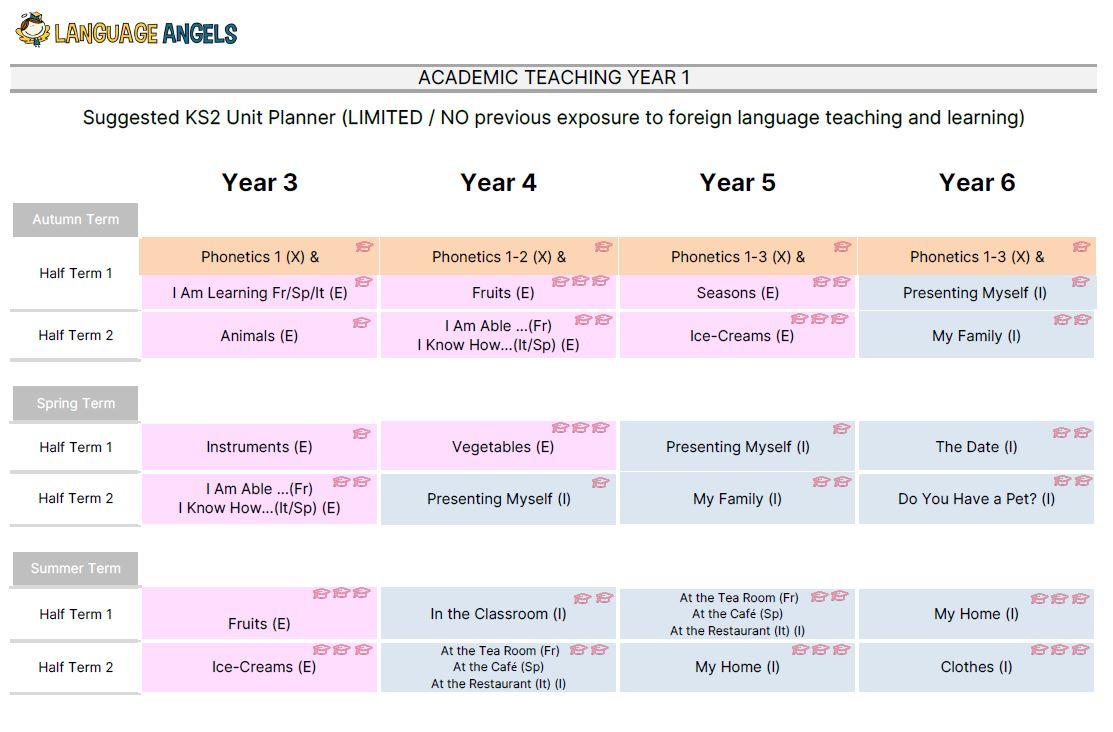
Language Learning Skills Progression - by Year Group
Helping with French at home ideas:
Here are some suggestions for ways you can help your child with French at home:
1. Take your child to a museum
France has produced some of the most talented artists, such as Monet and Renoir. Check your local museum’s schedule to see when it is featuring a French-inspired exhibition and enjoy a day out. Entry to museums is often free.
2. Celebrate French holidays
Celebrating important French holidays, such as Bastille Day, will teach your child about French history. Celebrate by making some fun crafts or taking part in holiday traditions. Similar to the Bonfire Night, the French display fireworks.
3. Cook a French meal
Familiarise your child with French cuisine by making a traditional French meal, such as quiche and crème brûlée.
4. Watch a French movie
Fire up Netflix and host a French movie night with your family. Here are some child-friendly French movies you and your child can enjoy: “A Monster in Paris,” “The Red Ballon,” and “Tintin and the Lake of Sharks.”
5. Listen to French music
Do you have a Spotify account? Download some French songs to listen to while at home or on the road. Listening to French music will help familiarise your child with French accents and pronunciations.
6. Puzzles
You can download and print dozens of free French crosswords and word searches for your child. He or she will have fun playing, while simultaneously learning French vocabulary and simple sentences. Keep a stack in the car for long road trips.
7. Memory game
Create some French flashcards and place them face down on a table. Your child will flip over two cards. If the pictures match, your child will flip over two more cards. The point of the game is to match all of the cards from memory.
8. Colouring books
Purchase a French colouring book; these colouring books will spark your child’s creativity, while helping them learn various vocabulary words and themes.
9. Read French books
There are lots of beginner French books. Le Petit Prince is one of the most well-known French children’s books. You can find the book in almost any book shop or online.
10. Hangman
This French activity is played exactly like the original Hangman version, except you are using French vocabulary words and phrases instead of English.