Fir TreeJunior School

PSHE
Why PSHE Matters
What is PSHE Education?
PSHE Education (Personal, Social, Health and Economic Education) is a planned programme of learning through which children and young people acquire the knowledge, understanding and skills they need to successfully manage their lives – now and in the future. As part of a whole-school approach, PSHE Education develops the qualities and attributes pupils need to thrive as individuals, family members and members of society.
What do schools have to teach in PSHE Education?
According to the National Curriculum, every school needs to have a broad and balanced curriculum that:
-
promotes the spiritual, moral, social, cultural, mental and physical development of pupils at the school;
-
prepares pupils at the school for the opportunities, responsibilities and experiences of later life;
-
promotes British values.
Our PSHE Curriculum
We are excited to be launching our new PSHE curriculum from January 2022 using the renowned 'Jigsaw PSHE' programme. After extensive research and consultation with our children, parents, staff and Governors, we have made the decision to adopt the 'Jigsaw PSHE' programme because it complements our curriculum through a child-centred, purposeful and mindful approach to learning and, at the same time, will enable our children to apply - in Greater Depth - their PSHE knowledge and skills to a variety of our already established wider curriculum areas such as British Values, Global Learning and SMSC.
The Jigsaw programme is organised as follows:
The Six Puzzles (Themes/Units of work)
There are six Puzzles in Jigsaw (quickly identified by their colour scheme) designed to progress in sequence from the beginning of each academic year:
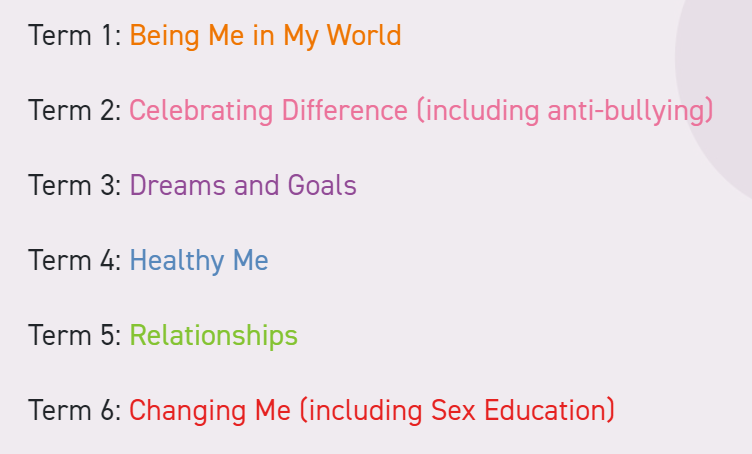
Each Puzzle has six Pieces (lessons) which work towards an ‘end product’, for example, The School Learning Charter or The Garden of Dreams and Goals.
Each Piece has two Learning Intentions: one is based on specific PSHE/HWB learning (purple) and the other based on emotional literacy and social skills development (green).
The whole school works on the same Puzzle at the same time, meaning that each Puzzle can be launched with a whole-school assembly and learning can be celebrated by the whole school in a meaningful way.
PSHE at Fir Tree
In September 2020, changes to the PSHE curriculum were implemented. All children across Key Stages 1 and 2 will participate in relationships and health education as part of their weekly PSHE lessons. Parents may not withdraw children from these lessons. Parents may still request the right to withdraw their child from sex education, you will be notified when these are approaching. The withdrawal request will be discussed in consultation with the Headteacher.
For details of our curriculum including Relationships and Health Education please see the curriculum guides on this page. If you have any queries please speak to your child's teacher.
PSHE Curriculum and Policy Documents
- PSHE at Fir TreePDF File
- Relationships and Sex Education Policy.pdfPDF File
- Being Me In My World Unit (Term 1) - Progression of Skills and KnowledgePDF File
- Celebrating Different Unit (Term 2) - Progression of Skills and KnowledgePDF File
- Dreams and Goals Unit (Term 3) - Progression of Skills and KnowledgePDF File
- Healthy Me Unit (Term 4) - Progression of Skills and KnowledgePDF File
- Relationships Unit (Term 5) - Progression of Skills and KnowledgePDF File
- Changing Me Unit (Term 6) - Progression of Skills and KnowledgePDF File